
Last modified: 2026-04-18 by ian macdonald
Keywords: australia | southern cross | stars: 7 points | construction sheet |
Links: FOTW homepage |
search |
disclaimer and copyright |
write us |
mirrors
See also:
This page discusses variants of the Australian National Flag (Australian Blue Ensign) that show significantly different design characteristics to those of the 1901, 1903, or 1908 (current) versions of the flag as asserted by the Australian Government in various publications. In particular it looks at flags created for government uses, and incorrect or questionable flag design information issued by government departments. These include incorrect dimensions, proportions, drawings and design templates.
Jeff Thomson, 11April 2026
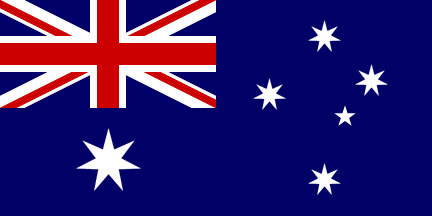 image by António Martins, 29 Jul 2008
If made according to the official statistics, star Epsilon Crucis on the flag of
Australia (as with the other stars) should have a centre imaginary circle
equal to four-ninths the outer, however, many illustrations show it with a
standard five-pointed shape. It occurred to us, therefore, to ask whether
the official prescription was observed in Australian flags actually flown?
Christopher Southworth, 27 July 2008
I have not closely examined this question, but from my casual observations, it appears that most better quality printed flags do show the stars correctly drawn. However, it seems that the practice has developed of "straight-lining" the star points for sewn (appliqué) flags. Thus, not only is the Epsilon star made in the style of a US star, but all the seven pointed stars are also made with a series of straight stitches, effectively making the inner circle have a smaller diameter than the official 4/9ths of the outer diameter. This effect is partly for the convenience of sewing and partly an affectation that the stars then "look better". In drawn images, the smaller inner diameter stars is probably due to the limitations of drawing tools such as found in Microsoft Word - which can only draw a US style 5-pointed star automatically and can only construct a 7-pointed star with a series of lines.
In the case of lower quality flags, the size, shape and placing of
the stars becomes very varied and casual. It is not unusual to see a
cheap imported flag with the Federation Star the same size as the
Crux Australis stars, which are often positioned smaller in the field
than is correct.
Ralph Kelly, 28 July 2008
Where my really new or modern all sewn (Australian made) are concerned, most are made with stars appliquéd via the "straight line method" as Ralph refers to it. With that said, I have several older all sewn samples where the builder took time to appliqué the 7 pointed stars correctly. In one of those cases, the 5 pointed star is also sewn on the flag correctly while on others, it is straight lined.
Others may have a different experience, but it has been my
observation that if a batch of all sewn/appliquéd flags is made up
specifically for the Australian government or military, they will
have stars that are fully correct in every way. We have a brand new
white ensign and a brand new "naval jack" (the Australian national
flag) in Dalat's connection. Both are built with fully correct stars.
Additionally each piece has a special label on the heading
identifying them as "government" property. We also have 3 fully sewn
RAAF flags at our disposal, all with correct stars.
Clay Moss, 28 July 2008
Clay Moss commented that this flag is not used under "strict government requirements". However, that is not the case with flags used by leading politicians. As recently
as a few days ago, the Australian Treasurer (Federal Finance Minister)
was interviewed on television at Parliament House in front of two
Australian sewn flags which clearly showed the same "straight edging"
of the Federation Star. I believe that all similar internal display
flags used by federal ministers are the same. The flags were probably
supplied by John Vaughan of Australiana Flags who has previously
confirmed to me that this treatment of the stars is both for sewing
convenience and because they "look sharper".
Ralph Kelly, 29 July 2008
Note that the official specification drawing in the first edition
(1995) of the Government publication "Australian Flags" [ozf95] had a
typographic error which showed the inner diameter of the Federation
Star to be 4/5ths of the outer diameter, rather than 4/9ths. This was
corrected in the second edition, but the original drawing is still
sometimes reproduced.
Ralph Kelly, 28 July 2008
A more significant error in specification occurred with the Flags Act
1953 which had an error in Schedule 1. The outer
diameter of the Commonwealth Star (also known as the Federation Star)
was described as three-eighths of the width of the flag, rather than
the correct three-tenths. This required the Parliament to pass an
amendment in Act 58 of 1954 to fix the error.
Ralph Kelly, 29 July 2008
Some further investigation of the Commonwealth Star outer diameter error described above by Mr. Kelly, reveals that the error was in the earliest drafts of the Flags Bill and continued through to enactment. When legislatively amended on 6 November 1954 the correction applied retrospectively to commencement of the Act on 14 April 1954. As the Commonwealth Stars in the enclosed colour plates were shown correctly, these did not have to be remade.
Further to the dimension errors of the 1995 first edition of the 'Australian Flags' booklet [ozf95] as also discussed by Mr. Kelly, the 1998 second edition [ozf98] showed Delta Crucis with inner diameter as 1/9 of its outer diameter (should be 4/9) and its centre as 1/9 from the fly middle line (should be 2/9). The 2006 third edition [ozf06] corrected only the first error (the Delta Crucis inner diameter) but retained the error of its centre position. However, it showed a new error of Epsilon Crucis outer diameter 1/7 of the fly width (should be 1/12). The 2022 third edition reprint finally displayed the flag diagram with no errors.
All of these flag diagrams have text printed vertically along the middle line of the fly, which although not wrong, is awkward to interpret due to its crowded placement. It reads as 'Middle line 1/24 1/16 1/15 of Fly'.
The 2006 third edition of the booklet also had an Australian Red Ensign error which was corrected in the 2010 reprint. An artwork of the red ensign showed it being flown from the jackstaff of a small yacht. The corrected artwork in the 2010 reprint showed the yacht sailing the other way, and the red ensign flying from the ensign staff. I suspect that in preparing the artwork for the 2006 booklet, the artist was misled by the equivalent artwork in the 1995 and 1998 editions. This was a rather clumsy rendering of a yacht that resembled a river barge with its exaggerated stern looking more like a bluff bow.
Jeff Thomson,
5 October 2025
In 1908 Mr. E Wilson Dobbs designed a large Australian Red Ensign for the Melbourne Metropolitan Board of Works. His design reinstated the original 1901 Southern Cross, combined with the new seven-point Commonwealth Star. This star layout coincided with that of the non-standard Australian Blue Ensigns flown by Australia's Navy from 1908. Some Government memos refer to the E Wilson Dobbs flag, but it is unclear whether they meant his actual red ensign, the Navy's flags, or any Australian flag with a seven-point Commonwealth Star. A British colour image of this variant was produced, and unlike the other images of the Australian flags of the time, it showed the blue and red flags accurately!
National Archives Item ID 30049777; page 14.
https://recordsearch.naa.gov.au/SearchNRetrieve/Interface/ViewImage.aspx?B=30049777
Jeff Thomson, 4 September 2017
A drawing of this variant prepared by Mr Wilson Dobbs was copied and issued by the Department of
External Affairs to public enquirers until around 1911 before being replaced by drawings of the
current flag. It was alleged in the 1950s that a colour plate of Mr Wilson Dobb's flags was enclosed
in the Gazette No 39 of 1908. If so, then it introduced the seven-point Commonwealth Star at the same
time and in the same Gazette number as the new Commonwealth Coat-of-Arms (also with the seven-point
Star) was proclaimed. This was over four months before the current Australian National Flag design
was formally changed from the six-point star to the seven-point star with the Imperial authorities!
Jeff Thomson, 8 February 2022
What is notable about the drawing and flag images is that they show the six-point Commonwealth Star as slightly 'pinched', rather than the Shield of David appearance normally associated with this flag variant. It is 'pinched' noticeably less than the six-point Commonwealth Star from the British colour plates as enclosed in the 1903 Commonwealth Gazette. In the 1901 drawing, the six-point Commonwealth Star has been constructed using the same drawing method as for the Southern Cross stars.
This flag drawing has raised doubts as to which method was intended to be used to draw the six-point Commonwealth Star, as both comply with the specified dimensions. One clue is that the inner diameter of this six-point star was specified as half of the outer star-point diameter, all other stars on the Australian flags being specified as the inner diameter being 4/9 of the outer diameter. This suggests that the six-point Commonwealth Star was intended to be of the Shield of David style. But this uncertainty also raises the question of who actually designed the 1901 flags, and how they combined and adapted elements of the five Federal Flag Competition winning entries into the definitive Australian flag design.
This uncertainty also applies to the badge on the 1902-1908 Governor-General's Union Flag. There are several artworks of this badge with it's 'shaded' six-point Commonwealth Star to be found in various file items in the National Archives. Some of the images show the Shield of David shape, others have the slightly pinched shape.
Jeff Thomson, 9 January 2024
National Archives Item ID 802025; page 240. https://recordsearch.naa.gov.au/SearchNRetrieve/Interface/ViewImage.aspx?B=802025
One theory as to how the 'all-six-points' variant came about relates to the Admiralty description of the flags. As the number of star-points of the 'White Six-pointed Star' was given, and no star-points given for the 'five smaller White Stars' in the fly, it appears that flag makers and others assumed that the Southern Cross stars were also of six points.
Jeff Thomson, 9 January 2024