Last modified: 2026-04-04 by  zachary harden
Keywords: ufe | unidentified flags |
Links: FOTW homepage |
search |
disclaimer and copyright |
write us |
mirrors
Please note our Policy for Submissions and Enquiries.
Below is a series of images of flags that have been provided to FOTW; some we have recognized, and some we have been unable to recognize. If you can help us identify any of these flags, please let us know! Contact the: UFE Editor.
Identification Key:
 = Positive ID (Positive Identification)
 = Tentative ID (Tentative Identification)
 = Some Speculation Tentative ID
 Image by Jennifer Leslie
Please help me identify this flag.
Jennifer Leslie, 7 January 2007
[This flag is very similar to UFE17-40, but missing the additional four stars added. There it is identified as a part a toy military set. - Ed.]
Positive ID

Speculative image by Peter Hans van den Muijzenberg, 25 October 2011
Could you please identify a flag on a uniform button as follows (if possible). The button is 22.5 mm diameter two-piece gilt spun back with the makers name Firmin, London on the back. It has a roped edge with an grommet inside that.- Lined background. The flag itself is a pennant on which is a diamond shape. On the diamond are the letters C & S. Unfortunately no colours are shown apart from the fact that the diamond has a deckled finish usually indicating in heraldic convention terms the colours of either yellow or orange. s a committee member of the British Button Society and a collector of shipping buttons for many years, I have had few problems in identifying the majority of buttons that come my way but this one really has me beaten - I had thought maybe a yacht or boat club burgee but somehow I don't think so. Unfortunately the backmark used by Firmin covers a number of years so pinning it down to a particular period is difficult- all I can suggest is that it could be any time post WW1 up to just after WW2 (early 50's).
Ian Scott, 9 January 2007
I've been in contact with Ian Scott, who asked us about this flag originally, and he wrote me on 10-10-2011 saying: "The button was identified a couple of years ago belonging to Cook & Son Nile Service Steamers. This is the famous Cook who really started the tourist trade in the mid-19th Century, but obviously they expanded and an obvious area was the river nile and the pyramids, etc. I believe someone spotted the flag on an advertising poster for holidays on the nile and the rest as they say is history."
With Ian Scott's help, I've created an approximation of the flag. As the background of the button has colour indicated, and the diamond has as well, I was tempted to say the field is meant to be white, for not having any colour indication. But it's an unlikely choice, so I stuck with the grey I tend to use for unknown details.
 Image #2 from Peter Hans van den Muijzenberg, 25 October 2011 (Click to enlarge)
Positive ID
 Image provided by Nelson Schmitt
I picked this flag up at an estate sale. I'm pretty sure it's Japanese and most likely WWII era. The previous owner was a WWII collector and dealer. Do you have any idea what flag it could be? I'm not even sure which way is up or whether it is flopped the right way. The top of the image is where it fastens to the pole but I don't know if it hangs down or outwards. Japanese flags seem to hang both ways.
Nelson Schmitt, 10 January 2007
This flag is a former version of the German KLJB banner. It was used up through the Nineties. KLJB means "Katholische Landjugend-Bewegung" (Catholic Farmer's Youth Movement), a large German catholic association for young farmers, founded in 1947, with 70.000 members today.
Werner Bußmann, 12 September 2011
The current logo can be viewed at Katholische Landjugendbewegung Deutschlands - Movement of the Catholic Rural Youth of Germany. (The following has been translated from submitted German text and paraphrased by the UFE Editor) The KLJB is among Germany's largest youth organizations with 70,000 members. Since 1947, the KLJB has represented the interests of young people in rural areas and is committed to an active and vibrant Catholic Church. In accordance with its guidelines, the KLJB supports a just and sustainable world and wants to be an example for eco-action, conservation and solidarity with people around the world. Its membership consists of young people and young adults 14 years or older. The KLJB headquarters are in the Bad Honnef Rhön village. Sources: http://de.wikipedia.org/wiki/KLJB and http://kljb.org/portraet.
Esteban Rivera, 24 September 2011
 Image rotated by UFE Editor
It should be noted that this flag was NOT intended to be be hung vertically, and that the strange-looking "axe" was actually a cross and plow.
Ned Smith, 27 September 2011
Four Positive IDs and one with Some Speculation
 Images by John Gorto
Can you help identify any of these badges? I think the "A" is Alaska Shipping, but the rest are unknown to me.
John Gorto, 7 February 2007
The blue flag with white cross and red diamond is the house flag of the Isthmian Steamship Co. and is identified on its proper page.
The flag with the white A on the blue circle on the red field is the flag of the Alaska SS Co. and is identified on its proper page.
The blue flag with red R on white diamond is that of C. Rowbotham & Sons (Management) Ltd. and is identified on its proper page.
The white swallowtail with a black "P" is the house flag of the Panama Railroad Steamship Co. and is identified on its proper page.
USBF stands for United States Bureau of Fisheries. (It also stands for United States Bridge Federation and United States Bocce Federation, but I don't think these run shipping lines).
Lesley Prince, 9 February 2008

Speculative image by Peter Hans van den Muijzenberg, 31 October 2011
I collect flag pins and recently acquired one interesting pin. It's a triangular flag - there's a red disc in the middle and blue rays on white background. If it were red rays I'd say the flag was Japanese. But this has left me in wonder.
Bojan Kotur, 8 February 2007
For this speculative image, I didn't take "in the middle" literally, as it's usually difficult to determine on a triangular flag, and I've picked 2:3 for the ratio, which gives it a rather burgee-like look. Unfortunately, I've not been able to contact Bojan Kotur for confirmation.
Peter Hans van den Muijzenberg, 31 October 2011
 Image by Steve Conroy
I've been searching and even thought I had a good lead with an Italian line, but no matches. Anything like this in your House Flag memory?
Steve Conroy, 15 February 2007
 Image by Rob Raeside
I recently bought a painting of a sailing ship (see this photo), which as you can see is a merchantman built, I imagine, about 1850. I'm not a sailor, even less an historical naval architect, and have no idea from the look of the ship where it might have been built or owned. Nevertheless I would like to know a little more about it, particularly whose house-flag is flying at the mast redrawn above. [The flag on the painting is not clearly identifiable, but I have been assured closer examination reveals it as shown here. - editor]
Rodney Russell, 28 February 2007
Some Speculation
 Image by Alan Rae, 5 March 2007
I am trying to identify two flags, which are shown on a pack of playing cards I bought while in Germany. The playing cards were made in Austria and judging from the styles of pictures on the cards they were probably photographed in the
thirties or forties. I have gone through your web pages and the flags have similar colouring to those of Hungary and Austria, but I could not find a match and I imagine that there was a considerable redrafting of flags in Europe in first half of the twentieth century. I have attached a scan of the flags and would appreciate any pointers you could give me to help me trace the flags and a period.
Alan Rae, 5 March 2007
I suspect that these are generic designs so chosen as not to be any national flag of the time.
Rob Raeside, 5 March 2007
These might be supposed to be the flags of USA and Bolivia. The US-flag was simplified to just 13 stripes without the blue canton and the stars. The white stripe in the Bolivian flag may be just a printing error.
J. Patrick Fischer, 6 March 2007
The red-white striped flag has thirteen stripes similar to the Merchants Flag of the American colonies, but the stripe width is not consistent.
Pete Loeser, 12 December 2009
Tentative ID
 Image by Claude and Bernard Sache, 9 April 2007
The attached photograph was taken by my parents last year in the Bukhara History and Local Lore Museum, housed in the Ark Citadel. The flag is shown in a window together with old weapons; there is no caption and nobody there was able
to say anything on the flag. The flag is green (most probably, in spite of looking black) with a red border and white charges, from left to right, the left hand of Fatima, horizontal and pointing to the hoist; a crescent pointing to the hoist; and three stars in a triangle, one "inside" the crescent and the two other ones placed vertically near the flag fly. The stars seems to point to the upper left corner of the flag but this is not sure since the flag is partially folded. These charges are also shown on the flag of the
Emir of Bukhara from the early XXth century.
Bernard Sache, 9 April 2007


Images located by Nombre Apellido, 11 June 2021
This is a Bhukhara military flag (not official). It is indeed from the Bukhara History and Local Lore Museum. A similar ceremonial flag is shown in the display case in the second picture.
Anonymous, 11 June 2021
Some Speculation
 Speculative image by Daniel Lundberg, 30 June 2016
I have purchased a silk flag that I have been unable to identify. It is 6ft. x 3ft., burgundy back ground with a shield in the center (light green color) with scissors on the shield and a lion above the shield. Surrounding the shield on both sides branches with large leaves that resemble holly leaves (green and gold) and at the top of this branch it resembles a poppy flower. There is a union jack in the upper left corner. At the bottom of the flag the date 1832 is embroidered. In the lower left corner, embroidered, is the name John Campbell, 1838. Any information would be greatly appreciated.
Sharon, forwarded by Al Kirsch, 15 April 2007
Above is a rough idea of what the this flag may have look like. I attempted to follow the description given.
Daniel Lundberg, 30 June 2016
 Speculative image by Peter Hans van den Muijzenberg, 2 July 2016
I moved the elements around a bit and re-coloured them slightly, for a better approximation of the description. I don't believe in red flowers on a red background, and the description is unclear about whether it's supposed to be a single flower or one per side.
But apart from that: The "name, year" embroidery suggests that this specimen was gifted that year to someone. On the other hand, the year below the charge would suggest the donating entity existed since 1832. Are there limits to what type of entity this could be?
Since they're using a flag that seems based on a UK red ensign, does this limit them to the UK, colonies, public entities, ...?
If we can get in contact with Sharon, I expect in this day and age it would be possible for her to provide us with a photograph.
Peter Hans van den Muijzenberg, 2 July 2016
I have have no way to follow up. Someone asked me about it (I'm a flag "expert" at AllExperts) and I passed it on to the list as a UFE. And there it sits. I admit I'm still stumped.
Al Kirsch, 11 July 2016
Positive ID
 Image seen on eBay by William Garrison, 15 April 2007
Seen on eBay - listed as "Flag, Russia, Civil War (1920s?), Regiment?" What is
this?
William Garrison, 15 April 2007
I'm not an expert on the subject but after a quick look at the Cyrillic alphabet, there doesn't seem to be an "inverted C" or "N" as on the flag so it is probably another alphabet.
Marc Pasquin, 15 May 2007
There certainly isn't an inverted C, Neither is there an "I", although that is used in some Cyrillic-influenced scripts such as Ukrainian and (IIRC) Serbian. for some reason (possibly the costumes of the people on the flag) I suspect it's actually Balkan rather than Russian.
James Dignan, 15 May 2007
It has flipped letters, so it must be Russian. Much simpler than do a quick search for "reversed C" and learn all about the "Ɔ"/"ɔ", which is BTW a kind of "o". This letter is used in many orthographies, especially in Africa (see e.g.
http://www.bakweri.com/2004/03/the_mokpe_alpha.html), and therefore call it "African UFE" would be a better hint. I would guess that this is one of those relatively rare canton-less Fante Asafo _frankaa_ (see Asafo company flags), but I may be wrong. Note that there's question marks for the date and regiment, not for the spurious and baseless attribution to Russia.
António Martins-Tuválkin, 16 April 2007
This flag has a text in Ashanti (Ghanese language) starting with "PONKO ABODAM" which means Crazy Horse (according to
http://prempeh.org/points/houses.html).
Sven S, 26 September 2008
Since the text on this flag seems to have been "positively" identified as Ashanti would it be better to also put this UFE on the Ashanti-related Page as an UFE? Having the two flags cross-linked might allow someone knowledgable enough about Ashanti flags to ID one, then just maybe the odds would be a bit better that he/she could ID the other. Seems to me it would be best that we present both UFEs together.
Ned Smith, 4 May 2010
This is an Asanthe-Asafo-Fante flag. It is described as an early painted example, possibly from the Victorian era, of a Fante Asafo Vintage Military Company Flag. The Fante/Fanti Asafo lived in the area of the Gold Coast of West Africa alongside the Ashanti, in what is now Ghana, and were formed into military companies for defense. They used many such flags to distinguish their various military companies or regiments. (sourse).
Anonymous, 12 July 2021

 Images by Rob Raeside
I recently came across two flags that I was told were possibly WWII Naval Japanese flags. They are supposed to be some sort of signal flags from what I was told.
Rick Thompson, 5 May 2007
Some Speculation


Orginal Photo of watercolour from Robert Dean, 16 June 2007
Speculative image by Pete Loeser, 23 January 2011
I have recently bought a watercolour, mid 19 century, of a yacht flying the White Ensign (post 1801) save that the vertical bar of the St George's Cross is blue, not red. The vessel also has a Flag Officer's pennant with the blue
vertical bar, and otherwise a red cross on a white background. Any ideas? Many thanks.
Robert Dean, 16 June 2007
I have no information about a White Ensign with a blue vertical arm on the St George's Cross (and no burgees of current yacht clubs appear show such a device), however, various White Ensigns of the St George's type were in use by yacht clubs between 1829 and 1842. According to Perrin (PP 137-9) The Royal Yacht Club (later the Royal Yacht Squadron of course) received a Warrant in 1829 and still flies the White Ensign, while the Royal Western, the Royal Thames, the Royal Southampton, the Royal Eastern and the Gibraltar Yacht Club had their's withdrawn on 22 July 1842. Due to an oversight the Royal Western Yacht Club of Ireland was missed and continued to fly theirs (which had a crown and wreath of shamrock in the centre) until 1859.
Christopher Southworth, 20 June 2007
The Royal Yacht Club of Tasmania's burgee is white with a bi-colour St George's cross. In this case it is the vertical arm that is red and the horizontal arm that is blue, with a crown at the centre of the cross. The club was founded in 1880 as the Derwent Yacht Club. It was not granted the title "royal" until 1910, so it is unlikely that the burgee bore a crown before that, and it may possibly have differed in other ways.
David Prothero, 22 June 2007
Some Speculation
 #19a
#19a
 #19b
#19b
 #19c
#19c
 #19d
#19d
 #19e
#19e
Speculative images using banneristic numbering by Peter Hans van den Muijzenberg, 17 May 2015
I have several new flags that I don't know what they are. Can you help please? They are all 100% cotton, 2' x 3', and they have a number RN32335. All colours are solid blocks.
Could "RN" be the (British) Royal Navy, and these a set of signal flags, for semaphore, maybe?
António Martins, 10 May 2010
I feel that the poster, Mr. Flag, was numbering in the banneristic way, clockwise, not the heraldic way, writing-wise.
I still can't figure these out, though. I wonder whether Mr. Flag knew where he got them from. You'd think they were sports signals of some kind, but who would need such complicated signal flags?
Peter Hans van den Muijzenberg, 15 April 2015
[Editorial Note: Peter Hans also noted that at UFE14-73 the same number, RN32335, was apparently used.]
Some Speculation
 Speculative Image by Pete Loeser, 19 January 2010
I briefly saw a flag I'm trying to identify, it was all yellow with a red cross crossing it and in the top right corner was some sort of green emblem. Any ideas what type of flag it could be?
Submitted to Albert S. Kirsch as an All Experts question, 31 July 2007
Every time I see this image, I can't help thinking I'm looking at the reverse side of the flag and the missing green emblem is in the canton, whatever it might be.
Pete Loeser, 30 September 2014
It need not be the reverse, as all we seem to have is "top right corner". Whose right that is, we don't seem to know, so the illustration may or may not be correct.
Peter Hans van den Muijzenberg, 30 September 2014
Some Speculation

 Images provided by Sal Giglia, 21 August 2007
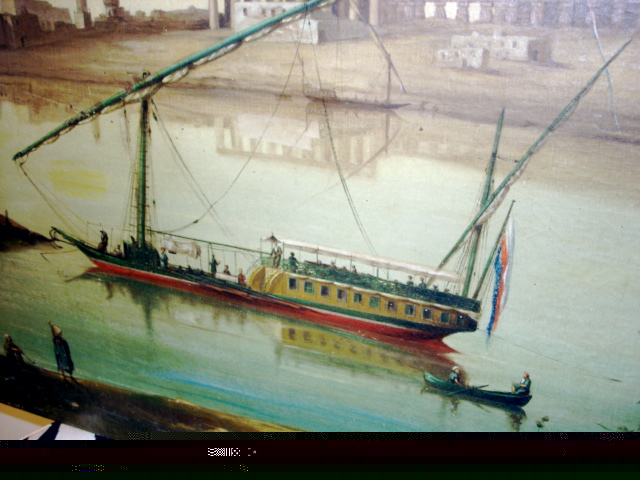
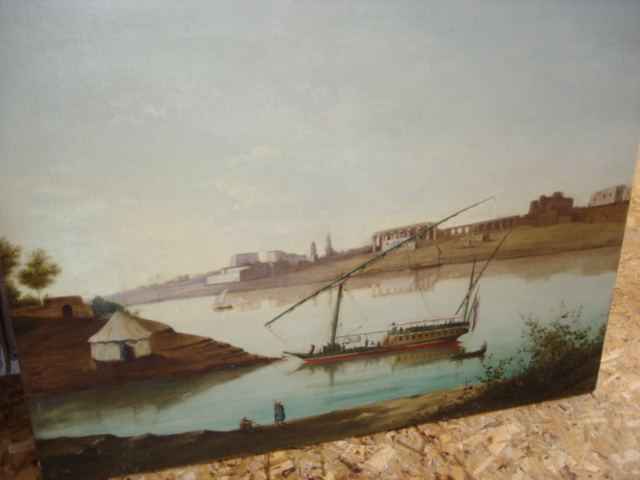
Enclosed are shots of a painting containing a flag...any thoughts? I thought it could be Bohemia-Moravia but that flag is too young for this boat. The boat is I believe a opium trade boat of the 19th century when it was fashionable for the
French and English to frequent such exotic trips to the Mideast. Larger images can be seen at
http://www.flagid.org/vexphotos/ufe/DSC04706.JPG and
http://www.flagid.org/vexphotos/ufe/DSC06532.JPG.
Sal Giglia, 21 August 2007
Possibilities are Schaumburg-Lippe or Slovakia 1848-1868, when the order of the stripes wasn't fixed to W-B-R. Both are in the time frame, but are a bit unexpected.
Peter Hans van den Muijzenberg, 21 August 2007
 Image by Clay Moss, 3 October 2007
I was watching Al Jazeera tonight and this flag popped up flying over a big mosque looking building. The camera stayed on the flag for a while, so I got a good look at it. I couldn't understand anything being said, but if I were a guessing man, I would say that story was coming out of Algeria or maybe Tunisia.
Clay Moss, 3 October 2007
 Speculative image by Eugene Ipavec, 4 October 2007
Quite recently I saw some new footage of President Ahmadinejad inspecting a parade, with a flag just behind him. This time I got a better look; the flag was green, with a wide black border, itself bordered in gold. In the two fly corners there were Iranian national emblems, also gold, tilted 45° - I assume these were also at the hoist, but the flag was partially furled. In the bottom fly corner there was an Iranian flag, also tilted 45 deg. This may also have been at all corners. Most of the green field was taken up by a large golden piece of calligraphy, which I here represent purely symbolically. It looked more angular than this, possibly Kufic-style. Also note that this bears a certain modest resemblance to the "Official Flag" of Hezbollah.
Eugene Ipavec, 4 October 2007
Some Speculation
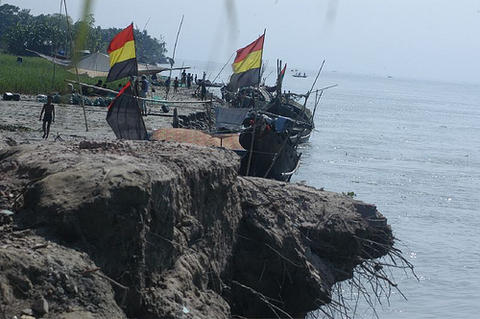 Image provided by hrothgar01usa, 1 November 2007
There is a series of articles on BBC's website, bbc.com, that describes a journey through Bangladesh to ascertain the effects of changing climatic patterns. In one photo, there are two unknown flags. I have uploaded this photo to the Photos section of the group. Any ideas as to what this is?
hrothgar01usa, 1 November 2007
Considering the general settings, it would seem as if the 'flags' are actually three flags each - monocolored banners are a major feature of devotional imagery in the Subcontinent, especially but not limited to Buddhists. While I can say
they are almost certainly likely to be some kind of prayer banners, whether they're permanent or temporary (in response to a recent event or crisis) and which group (ethnic or religious) is using them is beyond me.
B. Casey, 5 September 2008
 Image from Jerry Nelson
My eccentric mother of 80 years sent me a flag in the mail (for what reason, I can only guess Christmas), and she does not know what the flag represents. It is horizontal striped, tri-colored, much like Bolivia, but has the colors in this
order: Yellow-Orange-Green, or Green-Orange-yellow. I have looked at every flag picture I can find on the FOTW website and am out of leads. It is too orange to be red, and is a well made 3x5 [feet], nylon, maybe as early as the 70's i would
guess. There is no maker marks, just a "3x5" stamped on the white binding with brass grommets. She probably picked it up at a yard sale or thrift store, and there is no telling why she found it interesting enough to buy. She lives in Central Minnesota, and I don't think it is a college flag, but one never knows, maybe a high school or car dealership thing, but the colors don't make sense for high school.
Jerry Nelson, 20 December 2007
Some Speculation
 Image provided by Al Cavalari, 23 July 2007
Someone was told that the flag on the right is a Christian flag. Can anyone tell me from what sect, group or church it derives?
Al Cavalari, 23 July 2007
The wheel of life used by Indian tribes in the USA is identical to the Celtic cross used by right wing groups, given the white on red I would say this usage is native American, however, the photo is not perfect if the cross sections are not equal, then I would say this might be a one-time-type religious flag from some small Christian sect.
Rick Prohaska, 29 January 2008
I'm sure it hasn't escaped anybodies notice that if this is a Christian church's flag, it was a very poor design choice, especially in the deep South (Georgia) where this RV park is located. The use of the "sun wheel" on red reminds one of a multitude of extremist flags, i.e - KKK, Knights' Party, neo-Nazi, and other racially oriented National Socialist groups. I'd suggest the Church leaders (if indeed it is a church) rethink their design at the very least. Please spare me the "Celtic" connection arguments...
Pete Loeser, 23 September 2010
Perhaps more of a disturbing choice than a poor one. Without implying anything about churches in general, it is safe to say that there are some churches which themselves could well be described as extremist and racially oriented. But in any case, I don't yet see much reason to conclude that this in fact any church flag. That is based on a single second-hand (or maybe third-hand) report of unknown reliability.
Ned Smith, 25 September 2010
On a lark I found Jones RV Park, complete with a cropped image of the same main gate, so no flags. I called the number listed and was informed that the flag was put up and flown by the late owner's wife in honor of her husband. I asked about the symbolism of the flag and was told it was "A Christian Thing;" but that if I wanted more information I could call back when she was there. For those who wish to pursue this here is a lead.
Jim Ferrigan, 26 September 2010
I see that Jones RV Park has been contacted. I've never been able to do so over the net. I take it the suggested follow-up was never taken. Looking at this again, I wonder whether the charge actually is a sun symbol, or whether it's a letter C with a cross in it.
Peter Hans van den Muijzenberg, 30 December 2014
Some Speculation
 Image from M. Schmöger, 26 February 2007
In a report on the state of the Portuguese armed forces there is a photograph with M113 APCs, showing a flag in the background that looks a bit strange to me. It is a vertical, hanging flag, swallow-tailed, in the upper part blue, below divided of red and green. I can just guess that this refers to the national colours, but I can't explain the blue.
Source: Jane's Defence Weekly 1987: vol. 8, iss. 11, pp. 621-629.
M. Schmöger, 26 February 2007
Well, I've never seen anything even remotely similar to that, but usually these vertical banners, in Portugal, are more decorations than anything else. I wouldn't be surprised if this was the case, and I wouldn't be surprised if the blue was meant to refer to the European flag.
Jorge Candeias, 28 February 2007
Difficult without context. Does anyone have access to the relevant issue to see what's supposed to be in the photograph?
Peter Hans van den Muijzenberg, 30 December 2014
Is it my imagination, or is there a thin white line emblem on the blue canton? Maybe just reflection? The flag seems to be made of very thin material, doesn't it, so it is hard to tell? Can anybody make out what the pole is mounted on? It appears to be leaning outward, as from a banister on a railing.
Pete Loeser, 3 January 2015
My guess was that it's just the reversed print from the other side, which also shows in the rest of the image. I flipped the image, but there's not enough to make it readable. The pole looks to me like it's just a dirt-mounted pole. But this is why I was asking for more context. I don't even know what continent we're on. As far as I know, this might be the equivalent of a wind sock, somewhere. After all, the pole doesn't look like straight kind we'd hoist a representative flag on, and the flag isn't hoisted with a taut line.
Peter Hans van den Muijzenberg, 3 January 2015