- TAB
- A small piece of leather sewn into the sleeve of a flag fastened to a screw
head protruding from the staff, and designed to keep an indoor flag, parade flag
or military colour from slipping (see also colour 2)
and sleeve 2)).
Please note that this is an alternative to a grommet
and clip or decorative nails as methods of fixing a parade flag or military colour
to its staff. It should be noted also however, that the practice of tying a parade
flag or military colour to its staff, or affixing it with metal rings, is not
entirely obsolete (see also ties).
- TABARD
- 1) In US army usage, a trumpet banner – see
bannerette.
- 2) The formal surcoat worn by a herald on ceremonial occasions, and emblazoned
with those arms appropriate to the particular office involved (see also
coat of arms 2)).
![[tabards]](../images/v/vx-lordlyonking.png)
Court of Lord Lyon King of Arms, Scotland (heraldicjewelry.com)
- TABLE FLAG (or TABLETOP FLAG)
- A small flag, frequently mounted on a cross bar whose staff and stand make
it suitable for display on a desk or podium – a desk flag (see also
banneret 1), flaglet,
handwaver).
![[table flag example]](../images/v/vxt-d1298.gif)
Table Flag of Gračišće, Croatia
- TACK
- 1. The nautical term for a line which is spliced into (or attached to) a grommet or eyelet
at the foot of a flag’s hoist for securing it to its halyard
(see also
grommet 1),
hoist 2),
inglefield clips,
splice,
tackline).
- 2. A term for the lower hoist corner of a flag (see also hoist 2)).
- TACK PIN
- See belaying pin.
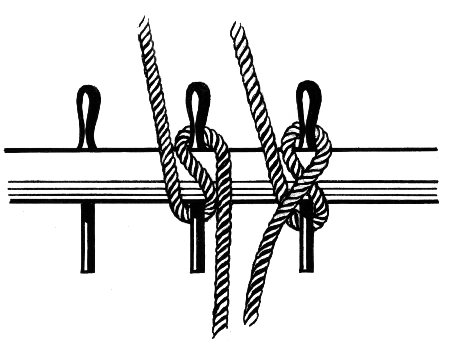
Tack/Belaying Pins (Wikipedia)
- TACKLINE
- A nautical term for a length of halyard fitted with inglefield clips
at both ends which is used to separate different signal hoists on the same
halyard (see also hoist 2),
tack).
- TAILS
- Two or more projections extending from the fly of a flag or the bottom edge of a
gonfalon, hanging
flag or banner, either varying in width/length or of even size, sometimes triangular or possibly
straight-sided with rounded, triangular or squared ends – tongues (see also
multitailed,
swallow-tail(ed),
triangular-ended tails).
![[tails]](../images/v/vx-hr-kr_ku.gif)
![[tails]](../images/v/vx-hr-vz_bh.gif)
![[tails]](../images/v/vx-hr-ri_bs.gif)
Gonfalon/Ceremonial Flags of Kumrovec,
Breznički Hum and
Baska, Croatia
- TAKBIR
- A term for the Arabic inscription Allahu Akbar (“God is greater”) that has appeared on
several Arab Flags and can currently be seen on those of Iran and Iraq (see also
shahada and zulfikar).
![[Takbir example]](../images/v/vx-pk}wz30.gif)
![[Takbir example]](../images/v/vx-ir.gif)
![[Takbir example]](../images/v/vx-af-pakh.gif)
Flag of the Waziristan Resistance Movement c1930, Pakistan;
National Flag of Iran;
Flag of Pakhtunistan, Pakistan
- TALONED
- In heraldry see armed
(also membered).
![[taloned example]](../images/v/vx-de-br).gif)
![[taloned example]](../images/v/vx-de-br.gif)
Arms and Flag of Brandenburg, Germany
- TANGLE ROD
- A metal implement attached to a flag pole (particularly one set
at an angle from a building) that clasps a flag and prevents it wrapping itself around the
pole (see also flag spreader,
outrigger pole,
weighted fly).
- TAPERED SWALLOWTAIL
- See broad command pennant,
broad pennant,
burgee 1),
burgee 2),
burgee command pennant.
![[tapered swallowtail]](../images/v/vx-no-comp.gif)
![[tapered swallowtail]](../images/v/vx-us~ycmbr.gif)
![[tapered swallowtail]](../images/v/vx-usbrgcp.gif)
Broad Pennant, Norway;
Burgee of the Bourne Yacht Club, US;
Burgee Command Pennant, USN (seaflags.us)
Please note that (in addition to the references given above) this term may
also be applied (as one example) to the flag of the state of Ohio.
![[Ohio]](../images/v/vx-us-oh.gif)
Flag of the State of Ohio, US
- TASSELS
- A decoration of twisted fabric or metal, often surrounding a wooden core and
hanging from a cord, attached to a staff or directly onto a flag – especially
a colour or parade flag (see also colour 2),
cord(s) 1),
lanyard 1),
parade flag 2)).
![[tassels]](../images/v/vxt-d1288.gif)
Ceremonial Flag of Abedim-Moncao (detail), Portugal (fisisco)
- TATZENKREUZ
- The German term for a cross pattée.
![[Tatzenkreuz example]](../images/v/vx-ch-ne008.gif)
Flag of Cortaillod, Switzerland
- TATZENSPITZKREUZ (or NAGELSPITZENKREUZ)
- The German term for the heraldic phrase a Latin cross fitchy –
see fitchy, latin cross,
cross of santiago
(also cross fitchy and
latin cross fleury fitchy).
![[Tatzenspitzkreuz example]](../images/v/vx-es-cu-vg.gif)
Flag of Villamayor de Santiago, Spain
- TAU CROSS
- In heraldry see cross tau.
![[tau cross flag]](../images/v/vx-es-t-alb.gif)
Flag of L’Albiol, Spain
- TELEGRAPH FLAG
- 1) In British RN usage now obsolete, the flag devised by Captain Sir Home Popham in 1800, and raised
prior to a signal hoist to indicate whether the following flags were to be deciphered using a signal book
or by his vocabulary code (see also code pennant,
finishing flag,
preparative,
signal flag).
2) Marryat's 1817 code (of signals for the merchant service) also showed a telegraph flag – but see
note b) below (also Marryat's code).
![[telegraph flag]](../images/v/vxt-d1083.gif)
![[telegraph flag]](../images/v/vx-myt~tele.gif)
Telegraph Flag in Popham’s Code;
Telegraph Flag in Marryat's Code
Note
a) With regard to 1), this system formed the basis of the RN naval code for over 100 years.
b) Regarding 2), exactly how this flag was in used in Marryat’s code cannot be confirmed at the present
time, however, it is not unreasonable to assume a similar meaning to that in Popham.
- TELEGRAPHING
- See semaphore 2).
- TEMPLAR CROSS
- 1) Generically a red cross of varying design representing the Medieval Order of the Knights Templar
– see bauceant and balcanifer.
2) Specifically, the cross of the Portuguese branch of the above order – see
rounded cross.
![[templar cross]](../images/v/vx-pt-mdrvc.gif)
![[templar cross]](../images/v/vx-rel-temp1.gif)
![[templar cross]](../images/v/vx-pt-fzz.gif)
Flag of Vila Chă de Braciosa, Portugal;
Bauceans Battle Flag;
Flag of Ferreira do Zêzere, Portugal
- TEMPLATE FLAG
- That flag whose colours and/or design form the model upon which other flags are based – an
archivexillum (see also core flag and
flag family).
![[template flag - Berlin]](../images/v/vx-de-be_c.gif)
![[template flag - Berlin]](../images/v/vx-de-be-cw.gif)
![[template flag - Berlin]](../images/v/vx-de-be-mt.gif)
Flag of Berlin, Germany, together with those of
The Charlottenburg-Wilmersdorf District and
Mitte District of that city
- TENNÉ
- A heraldic term for the colour orange – see mixed tinctures.
![[colour example]](../images/v/vxt-d555h.gif)
- TERRITORIAL ARMS (or COAT OF ARMS)
- See coat of arms.
od.gif)
Arms of Odesa Oblast, Ukraine
- TERRITORIAL CROWN
- See leafy crown.
rv-06.gif)
Arms of Dubno District, Ukraine
- TERRITORIAL FLAG
- See sub-national flag.

Flag of Altay Territory, Russia
- TERRY
- A heraldic term for the colour of earth – see proper.

- TEUTONIC CROSS
- A cross of varying design, but always black on a white field, and symbolic of the German Order of The
Brothers of St Mary of Jerusalem – see iron cross.
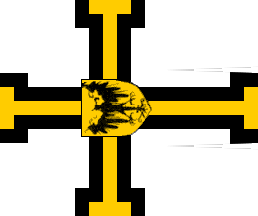

Flag and Arms of the Grand Master of the Teutonic Order c1500
Please note that this term should only be used when the cross so described has a direct
connection to the Teutonic Order.

![[table flag example]](../images/v/vx-hr-pn_gc.gif)