- FLAG
- 1) Generically, any piece of cloth (occasionally paper, plastic or metal) usually
with provision for attaching by one edge to a staff or halyard, generally (but
not exclusively) intended to fly freely in the wind, and which by displaying the
colours and/or the charges upon it, to act as a mark of identity, rallying point
or signal.
- 2) Specifically, the term is employed in opposition (by use, custom, tradition
or shape) to the more specific descriptions – such as (for example) colour, banner,
ensign jack or pennant as defined herein – see the entries under
ensign, as well as
colour,
jack and
pennant 2) with its following notes.
- 3) In British RN and some other usage, the term used (often in signalling) to describe the
authority/office of an admiral in command – see
flag officer 2)
(also flag of command 1)).
- 4) See flag down, to.

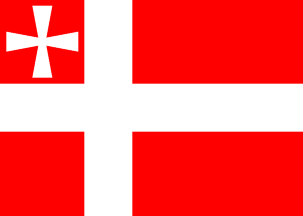
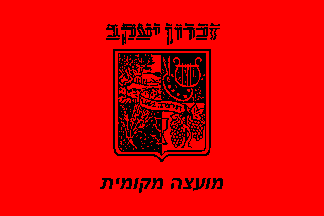
National flag of Samoa;
Flag of Volyinia Oblast, Ukraine;
Flag of Zikhron Ya'aqov, Israel
- FLAG ACT
- See flag law.
- FLAG ADJUTANT
- In US Navy and some other usage, the title carried by the aide to a flag officer –
the loop –, but see flag lieutenant
and the note below (also aiguillette
and flag officer 3)).
Please note that this appointment received its nickname – “the loop” –
from the aiguillette (in gold and blue cord with tassels) worn from the left shoulder by such
officers.
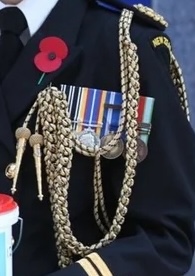
(reddit.com)
- FLAG ARMS
- A term used when the arms that appear on a flag are officially different from the
relevant national or provincial coat of arms or emblem –
see flag emblem (see also
armorial bearings,
greater arms,
lesser arms,
middle arms,
state arms under arms).
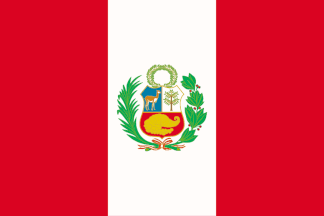
emb.gif)
.gif)

The State Flag and National Emblem of Peru;
National Arms and National Flag of Kenya
- FLAG BADGE
- See lapel flag 1).
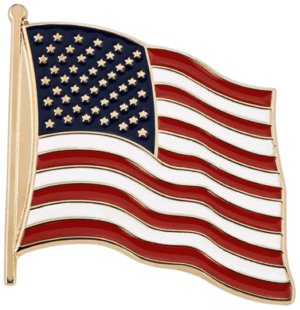
(hamiltoninsignia.com)
- FLAG BAG
- In US Naval usage, a colloquial term for the bridge locker in which
signal flag and ensigns etc are stored (see also
flags 1)).
- FLAG BEARER
- 1) One who carries any sub-national or
national flag when it is mounted on a hand-held
staff (see also flag carrier).
- 2) See colour bearer and
standard bearer 1).
- FLAG BELT
- A decorative band worn around the neck (often in national colours) or a leather strap worn around
bot the waist and neck, with a supporting socket into which the bottom end (or foot) of the staff is
fitted, and which assists a marching standard/colour bearer to
support its weight – a colour belt or sling (see also pike,
staff 2),
standard bearer 1)).
![[colour belt example]](../images/v/vx-colourbelt.jpg)
Flag Belt According to Spanish Regulations (Reglamento de Banderas y Estandartes, Guiones, Insignias y
Distintivos > Regla no. 12)
- FLAG BOOK (or FLAGBOOK)
- A collection of flag images and/or of flag information illustrated with such
images, that is published in book form or as a loose-leaf folder (see also
flag chart and flag plate).
![[flag book example]](../images/v/vx-adp1.jpg)
![[flag book example]](../images/v/vx-adp2.jpg)
Pages from the
Album des Pavillons (shom.fr)
- FLAG BURNING
- The wanton destruction of a flag by public burning, usually (but not exclusively)
for political motives – but see also ‘rules of preservation and disposal’ in
Appendix II.
![[flag burning example]](../images/v/vx-flagburning.jpg)
(visir.is)
- FLAG CANTON
- 1) See canton 2).
- 2) See canton flag.
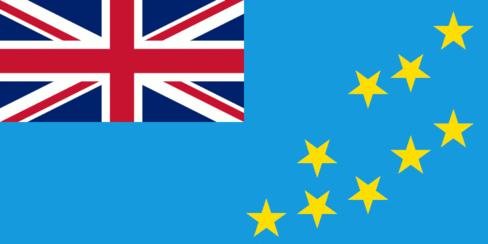
National flag of Tuvalu
- FLAG CAPTAIN
- In British RN, USN and some other naval usage, the Captain in command of any vessel
carrying a flag officer – see flagship and the notes below
(also
flag officer 1),
flag officer 2),
flag lieutenant).
Notes
a) An admiral does not command the ship that flies his flag, but has an officer
under him – the flag captain as defined above – who does (see also
flag of command 1)).
b) In British RN usage before 1958, this term would also have included those officers in command of any
vessel carrying a first class commodore, however, that rank is currently
in abeyance and a commodore (formerly a commodore of the second
class) now commands the ship himself.
- FLAG CARRIER
- 1) An airline – and in the past also a shipping line – that is considered
to represent the nation concerned and whose aircraft will usually carry a representation
of the national flag (see also
flag bearer 1)).
- 2) An airline or shipping line whose aircraft or ships are registered in a
given country and entitled to fly or display its flag.
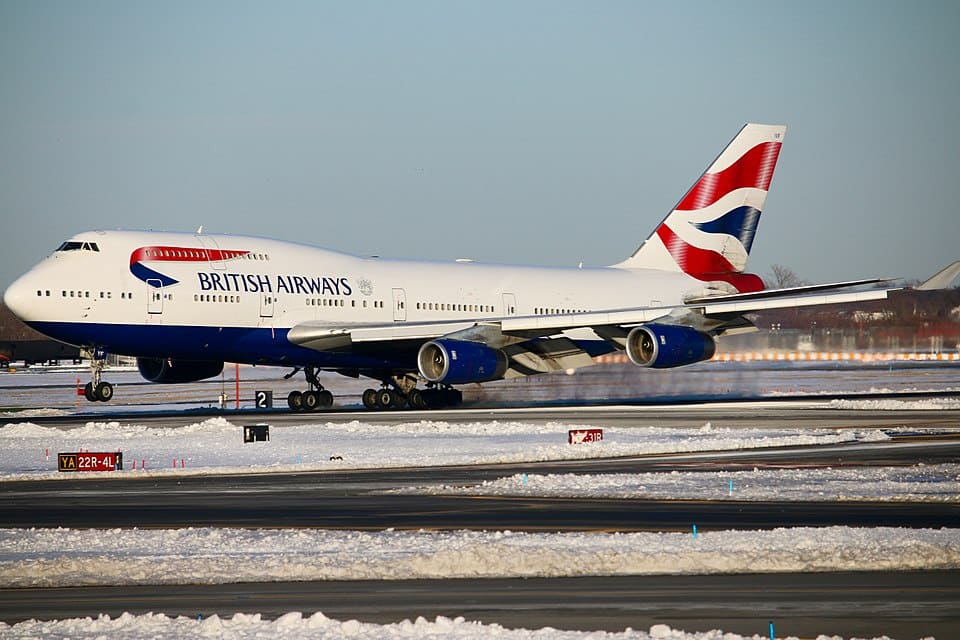
A Jumbo Jet of British Airways (Wikimedia)
- FLAG CASE
- 1) See case 1).
- 2) In US usage a triangular case designed to hold a folded flag secure
– a commemorative flag case
(see also flag folding
and pall flag).
- FLAG CHARGE
- A charge placed specifically on the field of a flag.
- FLAG CHART
- A collection of flag images produced on a single sheet, that is displayed
fully opened out and often rolled up or folded for storage (see also
flag book and flag plate).
![[flag book example]](../images/v/vx-flagcharteur.jpg)
Flags of Europe (pinterest.com)
- FLAG CODE
- A set of protocols to govern the correct and respectful usage of the national
flag. In some countries these are enforceable by law, but in others they remain
recommendations only – see Appendix II
(also flag etiquette, flag law,
rules of respect,
position of honour).
- FLAG DAY (or FLAG WEEK)
- 1) A holiday, commemorative day or other period of time for the affirmation of patriotic values
expressed in and through the national flag (see also
flag flying days).
- 2) In UK usage, the term that describes a charity event during which donations are acknowledged by
the receipt of a paper flag (see also flag flying days and
lapel flag 2)).
- FLAG DESIGN COMPETITION
- A competition (either official or unofficial) that invites designs from which a new or replacement
flag may be selected – usually by a committee appointed for that purpose (see also
ausflag and flag proposal).
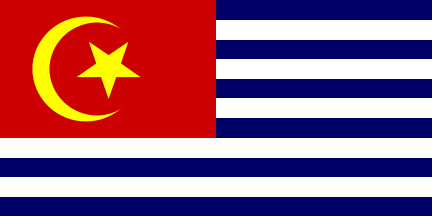
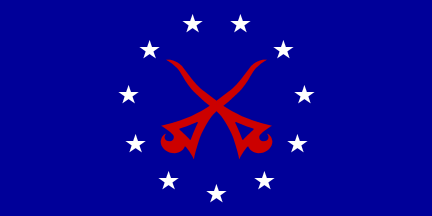
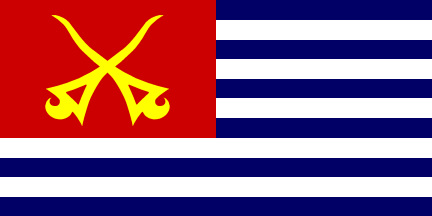
Three Rejected Entries in the Design Competition for a National Flag of Malaysia, 1949
- FLAG DISC (or DISK)
- In the British Royal Navy and in some others, an (appropriate) metal disc
displayed on boats carrying an officer of flag rank to indicate whether that officer
expects full ceremonial passing honours, or whether they are proceeding informally
and only require normal side party salutes (see also
boat flag 3),
flag officer, royal plate).
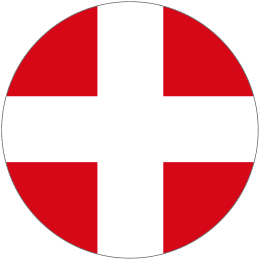

Alert and Salute only; Courtesy Salute Only, RN (Graham Bartram)
- FLAG DISCRIMINATION
- The often legal requirement for shippers to choose the national flag carrier,
airline or shipping company over others (particularly but not exclusively foreign
lines) when shipping goods or transporting people (see also
flag carrier).
- FLAG DOWN, TO
- (v) To signal a vehicle to stop or slow down as a warning of danger or obstruction on a road or
railway, by waving a (usually) red flag, slowly up and down, or by using only the
hand by day or torches by night in similar fashion.
- FLAG EMBLEM
- A term used when the emblem that appears on a flag is officially different from the
relevant national or provincial emblem (although it may contain an element or elements from
that emblem) – see
emblem, state or national (also
emblem 2),
fin flash,
flag arms).
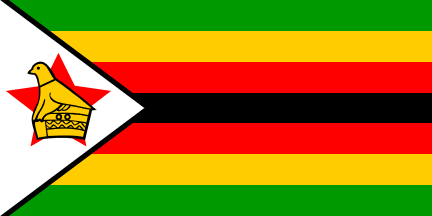
.gif)
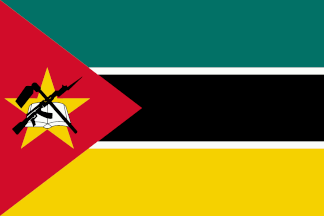
National Flag with flag Emblem, Zimbabwe;
Flag emblem, Uganda;
National Flag with flag Emblem, Mozambique
- FLAG ETIQUETTE
- The international customs applicable to the display of flags when flying together
– see Appendix II and
rules of etiquette (also
flag code, flag law,
position of honour).
- FLAG EXCHANGE
- 1) The term – and a translation of the German Flaggenwechsel –
which may be used to describe the point during the fitting out of a vessel when the builder’s
house flag is replaced with that of its new owners (see
also launching flags).
2) See souvenir flags 1).
- FLAG FAMILY
- A group of flags that share a common heritage or feature, usually shown in either
the colours used or the design employed, or in both – see
pan-african colours,
pan-arab colours,
pan-slavic colours
(also core flag,
differenced,
dutch colours 1),
garvey colours 1)).
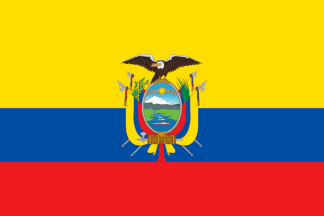
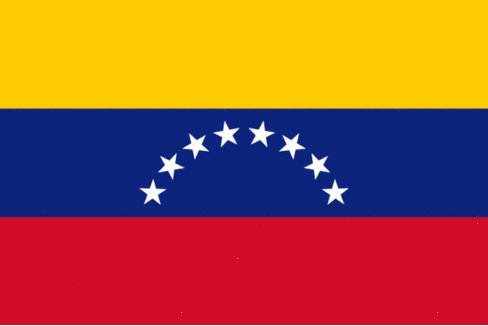

National Flag of Ecuador;
Civil Flag/Ensign of Venezuela;
National Flag of Colombia
- FLAG FLYING DAYS
- An official list of occasions upon which flags must be flown, generally (but
not exclusively) from public buildings (see also flag day 1)).
Please note that the list of flag flying days usually refers only to the relevant national flag, but
that there are several exceptions.
- FLAG FOLDING
- Specifically in US and some other – particularly (but not exclusively) military
and naval – usage, the precisely prescribed and ceremonial folding of the national
flag or ensign for presentation and/or storage (see also
flag case 2) and
pall flag).
![[folding the US flag]](../images/v/vx-flagfolding.jpg)
(allplanttraining.co.uk)
- FLAG FOR SLANTED (DIAGONAL or OBLIQUE) DISPLAY
- In South American usage and in some others, the phrases that may be used when the design
of a flag, or of any element thereon, is orientated so that it appears horizontal when
displayed from a diagonally mounted or held staff, (usually but not invariably) for indoor
use or when carried over the shoulder on parade – a tilted flag, a diagonal, oblique or
slanted display design or flag but see rotated (also
indoor flag and parade flag 1)).
![[Pont-à-Celles]](../images/v/vx-d1308.gif)
![[Pont-à-Celles]](../images/v/vx-d1307.gif)
Flag of the Chairman of the Joint Armed Forces Staff, Peru; Flag of the Army, Bolivia –
Both For Slanted Display (fotw & CS)
- FLAG HEIGHT
- See width 1).
![[flag height]](../images/v/vx-d1579a.gif)
- FLAG HOIST
- See signal hoist.
![[flag hoist]](../images/v/vx-ics~golf.gif)
![[flag hoist]](../images/v/vx-ics~nove.gif)
![[flag hoist]](../images/v/vx-ics_2.gif)
GN2 (Golf–November–2)
in The International Code of Signal Flags or
“I will take off persons”.
- FLAG LAW (or FLAG LEGISLATION)
- The legal means, by which any constituted authority establishes, regulates,
defines or amends a flag – flag legislation or a flag act (see also
Appendix II,
executive order,
flag code,
flag etiquette,
official flag 1),
precedence,
presidential decree,
position of honour,
royal decree,
presidential decree,
royal order in council,
specification sheet,
type flag,
warrant).
- FLAG LIEUTENANT
- In British RN and some other usage, the title carried by the aide to a flag officer
– but see flag adjutant
(also flag captain,
flag officer 2)).
![[flag lieutenant]](../images/v/vx-flaglieut.jpg)
Flag Lieutenant, Royal New Zealand Navy (reddit.com)
Please note that the title derives from that
officer’s former principal responsibilities (now superseded by modern
communications methods) for the handling of an admiral’s flag signal traffic –
see signal flag
(also yeoman of signals).
- FLAG LOCKER
- In British RN and some other usage, the area in which signal flags,
flags of command and ensigns etc., are stored aboard ship (see also
bunting tosser,
flags 1),
yeoman of signals).
- FLAG MAST (or FLAGMAST)
- See flag pole (also mast 1),
pole mast,
staff 1),
staff 2),
stayed mast).
Please note that the terms flagstaff, flag mast
and flag pole may be considered as interchangeable, but that ‘mast‘ and ‘staff’
when used alone have specific meanings.

.jpg)