- VEXIFERRET
- A colloquial term for one who undertakes an assiduous search for (sometimes obscure)
flag information (see also vexiferreting below and
vexillologist).
- VEXIFERRETING
- A colloquial term for the assiduous search for (sometimes obscure) flag information (see also
vexiferret above and vexillologist).
- VEXILLARIUS
- 1) See vexillifer.
- 2) A member of a Roman military unit (vexillatio) detached from the main force under a
vexillum – but see vexillation
(also vexillifer).
- VEXILLARY
- 1) (adj) Of or pertaining to flags (see also vexillology).
- 2) See vexillifer.
- VEXILLATION
- Any detachment of soldiers serving under a vexillum – but see
vexillarius 2) (also banderium,
vexillifer).
Please note this term is taken directly from the Latin vexillatio being a
detachment of soldiers as described above.
- VEXILLATOR
- A 19th century term, now obsolete, for the standard bearer in a medieval mystery
play.
- VEXILLATRY (or VEXILLOLATRY)
- The treatment of a flag as a fetish or religious object.
- VEXILLIFER
- The bearer of the vexillum
(see also vexillarius 2) and vexillation).
-
![[vexillifer]](../images/v/vx-vexilliferflav.jpg)
(firstlegionltd.com)
- VEXILLOBIBLIOPHILE
- A person who loves and/or collects flag books (but see also
vexillophile below).
- VEXILLOGRAPHER
- A designer of flags, or the creator of a flag design.
- VEXILLOGRAPHY
- The designing of flags, or the creation of a flag design.
- VEXILLOHOBBYIST
- A collector of flags and/or artefacts concerning flags – but see
vexillophile.
- VEXILLOID
- 1) A rigid emblem (such as a carved animal or similar) mounted on a pole,
which fulfils the function of a flag but which is not a flag, and characteristic
(but not exclusively so) of traditional societies – not to be confused with a
tufa (see also cone flag,
symbol 1), tugh).
- 2) As above, but the forerunner of the flag as in the Nome standards of ancient
Egypt, the semeia of classical Greece or in the Eagles of a Roman legion – a proto-flag (see
also eagle 2),
standard 4),
symbol 1)).
- 3) See standard 6).
![[Nome Standard of Djeb]](../images/v/vx-d1680.gif)
Nome Standard of Djeb, Ancient Egypt (philae.nu)
- VEXILLOPHILATELIST
- A student and/or collector of flag related postage stamps and/or of related
information.
- VEXILLOPHILE
- A collector of flags and/or of information regarding flags – a flag enthusiast
but see vexillohobbyist
(also vexillobibliophile).
- VEXILLOLOGIST
- A student of vexillology.
![[vexillologist]](../images/v/vx-andriesburgers.jpg)
The late (Rear Admiral) Andries Burgers SAN (ret)
- VEXILLOLOGY
- The scholarly or scientific study of the history, symbolism and/or usage of
flags – flag research or flag studies.
Please note, the term was coined by Dr. Whitney
Smith of the Flag Research Center (Massachusetts, USA) and based on the Latin
vexillum (see also vexillologist).
- VEXILLONAIRE
- A person who is active in flag design or usage, or is engaged in promoting a specific agenda and/or
point of view with regard to flags.
- VEXILLOPHILY
- The collection of flags and/or of information regarding flags (see
vexillophile above).
- VEXILLUM
- An ancient Roman standard consisting of an often decorated (usually) red or purple
cloth hung from a cross bar. It is considered to be the first true flag in Western
culture, and from which the term vexillology is derived (see also
vexillarius, vexillifer,
vexillation).
![[Roman vexillum]](../images/v/vx-it_leg13.gif)
Vexillum of the 13th Legion
Please note however, that whilst frequently described as a cavalry standard (which it was),
the vexillum also had a number of other military uses.
- VEXILLUM REGALE
- A medieval term, now obsolete, for the royal standard – see
royal standard 1).
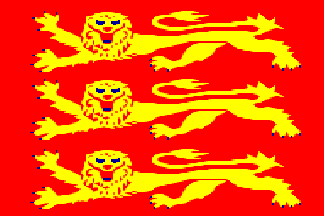
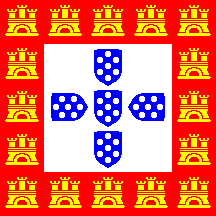
Vexillum Regale/Royal Standard of King Richard I c1290, England;
Vexillum Regale/Royal Standard of King Afonso III c1255, Portugal
Please note that it is unclear whether the medieval
chroniclers were referring to a banner of the royal arms as is common today, or
to a standard of the heraldic pattern known to have been used by many English
kings in the medieval period (see also standard 4)).
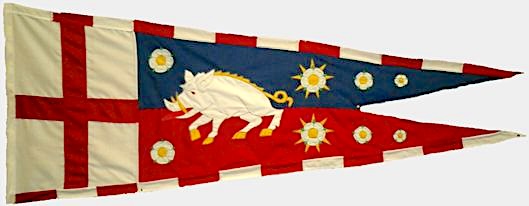
Heraldic Standard of King Richard III c1484, England
- VEXILLI ERECTIO
- A medieval term, now obsolete, for the fixing of banners or standards to the walls
of a fortress (see also banner 1) and
standard 4)).
- VICTORY MARKINGS (or VICTORY DECALS)
- The emblems, often the relevant national flag or a detail therefrom, painted on the fuselage of
military aircraft to record a victory in individual combat with that enemy – victory decals (see
also aircraft markings).
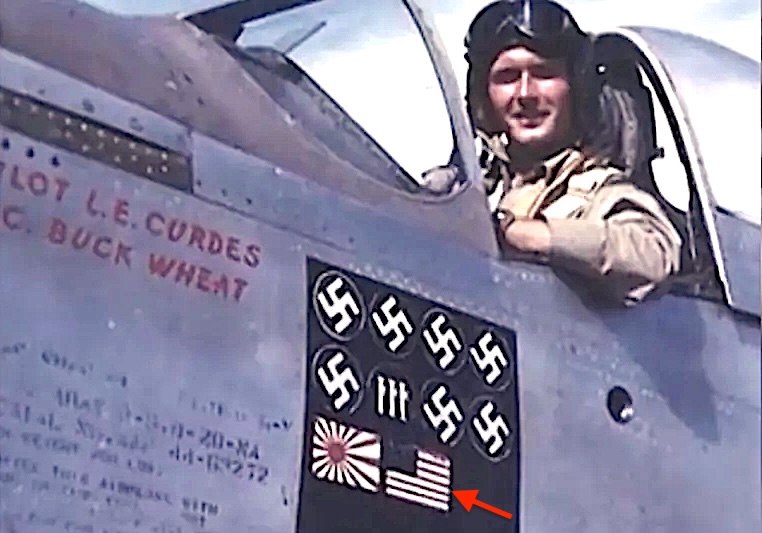
An Aircraft of WWII showing Victory Markings (wearethemighty.com)
Please note that the practice was established in WWI, and includes victory markings applied to other
pieces of military equipment as appropriate.
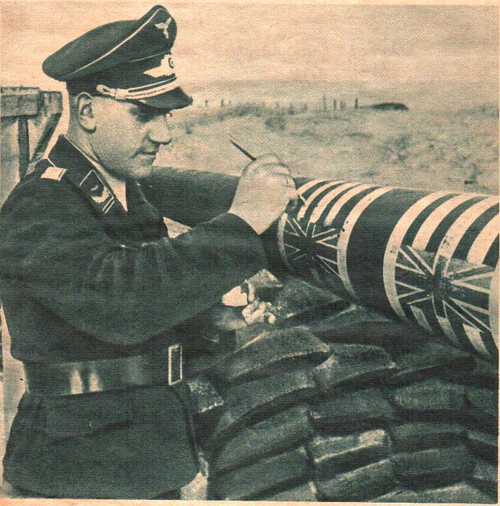
Kill markings, German Artillery c1940 (ww2incolor.com)
- VIGILANT
- The heraldic term sometimes used when a marsh bird (or occasionally – although incorrectly
– a fowl) is shown with one foot raised, and (usually) holding a stone or other object.
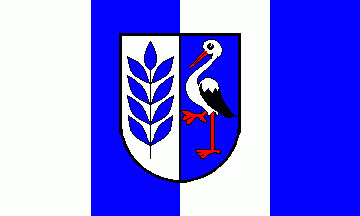
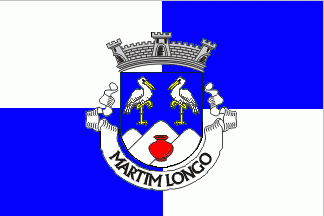
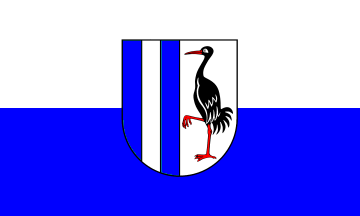
Flag of Jatznick, Germany;
Flag of Martim Longo, Portugal;
Flag of Jerichower Land County, Germany
- VILLAGE CROWN
- See mural crown 2) and its following note.
lv-bo.gif)
lv-vs.gif)
Arms of Borshevichi and
Velykosillya, Ukraine
- VIMPEL
- See wimpel.
- VINE
- The plant upon which (usually wine making) grapes are grown, and is almost invariably shown bearing
bunches of those grapes.
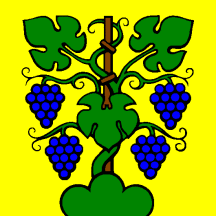
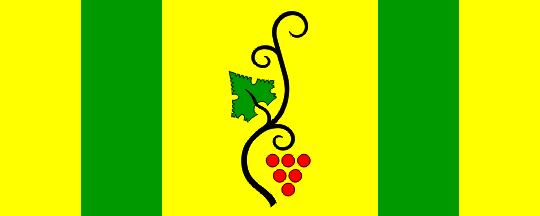
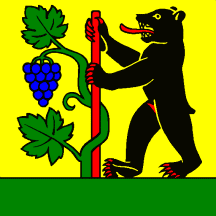
Flag of Zeiningen, Switzerland;
Flag of Podlehnik, Slovenia;
Flag of Berneck, Switzerland
- VIRILED (VILLENÉ or VILENE)
- See priapic in its virility.
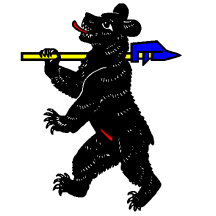
Flag of Speicher, Switzerland
- VISITING FLAG
- In New South Wales usage, now obsolete, the term for a plain blue flag hoisted (by the local pilot)
aboard any visiting vessel prior to being boarded by a health inspector (see also
quarantine flag).

Please note that this flag was introduced in the 1840s, but the date upon which it became
obsolete is unknown at the present time.
- VISUAL CENTRE (or CENTER)
- The term used when a charge is not set in the exact geometric centre of a flag, section of flag
or of the panel it occupies, or on a vertical or horizontal
meridian of that flag, section or panel, but is placed as to appear
so centred to the observer – but see note below (also
optical proportions).

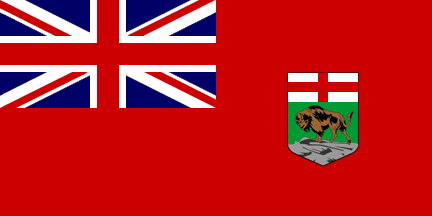

Civil Ensign of Japan 1870–1999;
Flag of Manitoba, Canada;
Flag of Eusoff Hall, University of Singapore
Please note that the examples given above show the pre-1999 merchant flag
of Japan with its disc set slightly towards the hoist, the arms on the flag of Manitoba placed a
little below the horizontal meridian and the flag of Eusoff Hall with a charge set on the vertical
meridian but above the horizontal.
- VLAGGENSTOK WIMPEL
- The Dutch term covering any wimple/pennant flown from a flagpole – see
wimpel 1) and wimpel 2).

Royal Wimpel, The Netherlands
- VOID
- In heraldry see ajouré and
open (also voided).
.gif)
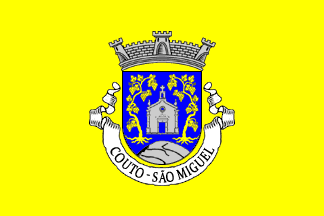
Arms and Flag of São Miguel do Couto, Portugal
- VOIDED
- A basically heraldic term that is applicable to any ordinary
(or other charge) when the middle is removed so that the field of a shield or banner of arms may be seen
through it (see also charge 2),
cross-voided,
mascle,
pierced 2)).
![[voided examples]](../images/v/vx-d615.gif)
Please note that in vexillology a voided cross such as shown above may, for example
(and with equal accuracy) be described as “a red cross, fimbriated yellow on a red field”
or similar.
- VOIDED CROSS
- In heraldry see cross-voided.
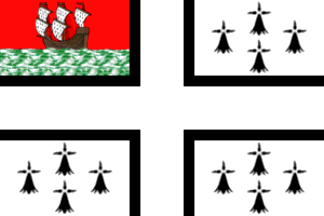
Flag of Nantes, France
- VOIDED LOZENGE
- The term for lozenge from which the centre has been removed thus
leaving an outline only – an open lozenge or lozenge-voided
(see also mascle and voided).
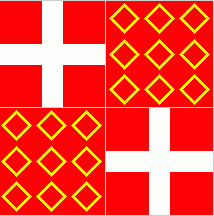

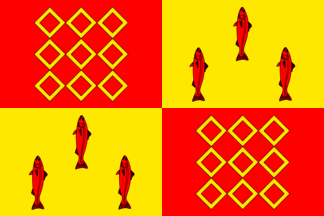
Flag of Grandmaster 1775–1797, Sovereign Military Order of Malta;
Flag of Morlanwelz, Belgium;
Banner of Arms of the Rohan-Chabot family, Josselin, France
- VOIDED (or VOID) TRIANGLE
- The alternative terms for a triangle from which the centre has been removed leaving an outline only
– a triangle voided or void triangle (see also
voided lozenge).
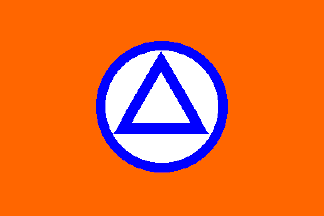


A flag of the Flemish National Union, Belgium);
Low Visibility Roundel, Austria;
Flag of the YMCA, Kosovo
- VOL
- The French heraldic term for a pair of wings conjoined at the base and placed with the tips upwards or
differently orientated, and sometimes (albeit incorrectly) used when only a single wing is shown –
but see demi-vol and volant
with its following note (also conjoined 1),
plus rising and displayed).

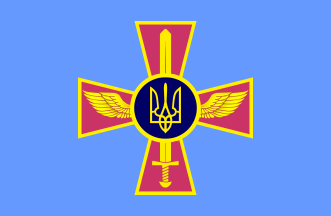

Flag of Šenkovec, Croatia;
Air Force Flag of Ukraine;
Air Force Flag (1937–1948), Taiwan
- VOLANT
- The heraldic term for wings, and sometimes (but not invariably) used to signify that those wings are
extended in a horizontal position as if in flight – but see note below (also
vol above, plus rising and
displayed).
![[volant example]](../images/v/vx-ch-sz001.gif)
![[volant example]](../images/v/vx-no-15-73.gif)
![[volant example]](../images/v/vx-pt-fcrfq-pa.gif)
Flag of Einsiedeln, Switzerland;
Flag of Smøla, Norway;
Flag of Penha de Águia, Portugal
Please note that these two terms (vol and volant)
can have a rather complex use, and we suggest that a suitable glossary or
dictionary of heraldry be consulted for further details.
- VULNED (or VOULNED)
- The heraldic term for wounded and bleeding, which is often applied to a pelican – see
in her piety.
![[vulned]](../images/v/vx-us-la.gif)
Flag of Louisiana, U.S.
- VYTIS CROSS
- In the Lithuanian tradition, a cross with two (evenly sized) horizontal arms crossing the
vertical – see cross of lorraine with its following
note, and the note below.


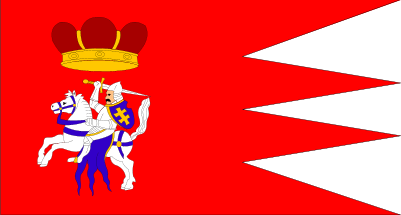
Naval Ensign 1927–1940, Lithuania;
Aircraft Marking, Lithuania;
Flag of the Grand Duchy of Lithuania c1580
Please note that the Vytis (or White Knight) has been a symbol of Lithuania since the 14th century, and
that he has borne this cross on his shield from the beginning.
